GEO / OPERATING MODEL
If you handed us a SaaS company on Monday and asked us to prepare it for AI Search in 90 days, the answer is yes, and the framework we’d run is CITE: Catalog, Identity, Trust, Evidence. The harder question is what we’d refuse to ship inside those 90 days, because the wrong sequence costs you the quarter.
Most AI Search readiness projects fail at the scoping conversation, not the execution. They get framed either as a one off audit that ships nothing durable, or as an open ended retainer that never closes the budget conversation. Neither matches how SaaS companies move, and both produce the same outcome a quarter later, which is that the in house team can’t point to a number and the board stops funding the work.
The framing matters because AI Search readiness isn’t a list of tactics. It’s the output of four layers running in parallel with the right sequence, and the wrong order costs you the quarter. We call that framework CITE, and the rest of this article walks through what it looks like in practice for a SaaS company that has decent classic SEO, no serious GEO work yet, and a brand that’s shipped. The operating model we run for SaaS clients is the productized version of what follows.
Why 90 days is the right window
Three things in a SaaS company’s calendar happen on a 90 day rhythm. There’s one CEO level decision in the cycle. There’s one board review. And there’s one measurement window long enough to see whether branded search lifted. 90 days is the smallest window that lets all three of those rhythms run together. Below that, the work is theater. Above that, the engagement loses momentum and the budget conversation never closes.
The other reason is that the work itself has a shape. Some of it ships in week one. Some of it accumulates over a quarter. Some of it runs from day one and never stops. 90 days is the smallest window that respects all three cadences without forcing the slow work to look fast or the fast work to look strategic.
Figure 1 · scoping
Why most AI Search projects fail before week one
The CITE framework
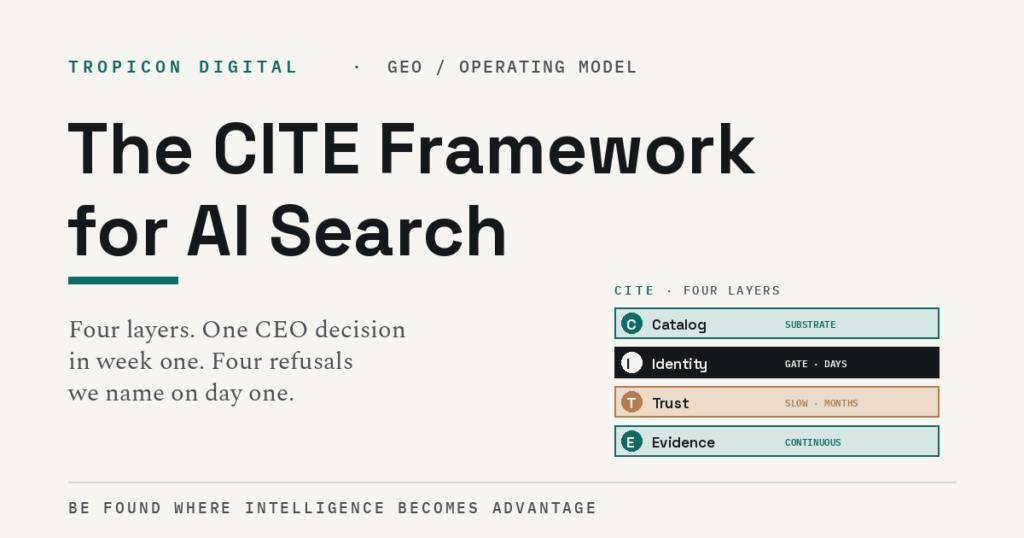
CITE stands for Catalog, Identity, Trust, and Evidence. These are the four layers we run in parallel for every SaaS client. They aren’t phases or steps. They start at different times, they accumulate at different rates, and they only produce AI Search visibility when all four are running together.
Catalog is the substrate. Organization schema, Person schema for the founder and key spokespeople, Product and Offer schema, FAQPage markup where it earns its keep, a pricing page an agent can parse without breaking, and a sitemap that exposes the right URLs. The point of this work is no longer rich snippets. Loren Baker demonstrated at SEJ Live that a Person schema fix can correct a wrong CEO name in AI Overviews within days. Structured data is now an LLM input, which makes the Catalog layer load bearing in a way it has never been before.
Identity is the non delegatable decision about what the company will let AI engines surface. Pricing tiers, customer names, technical documentation, founder commentary, the negative case study from 2023 that the company has been ignoring. This is the CEO level conversation in week one, it is the source of the “what we refuse to ship” list later in this article, and it’s the reason CITE can credibly tell some companies the answer is wait.
Trust is the slow layer. Third party validation, the right reviews on the right platforms, named customers with consent, coverage in top tier press, presence in the communities the buyers spend time in. LLMs look for both pros and cons when answering brand questions, so the negative review the company has been ignoring will be in the AI answer whether the company likes it or not. The only durable response is to outweigh it.
Evidence is the measurement layer. Branded search lift, prompt panel monitoring, AI Overview audits, the one page board story. It runs from day one. It has to, because without baselines on day one, there’s nothing to defend on day ninety.
The lead times differ on purpose. Catalog ships in weeks because it’s substrate work that engineers can execute against a clear brief. Identity ships in days but blocks everything downstream until it does. Trust accumulates over months and doesn’t finish inside 90 days. Evidence is continuous from day one. The 90 day plan is what it looks like when you run all four together with discipline.
Figure 2 · the framework
CITE: four layers, four lead times, one operating model
Days 1 to 30, the Catalog ships and the Identity decision lands
The first 30 days do two things. We ship the Catalog work because it’s the substrate everything else depends on, and we get the Identity decision out of the CEO so the rest of the work has a brief.
Week one is the Identity conversation. The question we put on the table is what the company is willing to let AI engines surface and what it isn’t. Reuters and Time blocked AI bots by default in 2026 because their business model depends on paywalled content. SaaS usually wants the opposite, which is controlled surfaceability inside guardrails. The decision isn’t whether to be findable, it’s what’s allowed to appear in an AI answer with the company’s name attached. We don’t start the technical work until that decision is signed off, because every later choice references it.
Weeks two and three are Catalog. Organization schema. Person schema for the founder and key spokespeople. Product and Offer schema on the product. FAQPage markup on the pages where it earns its keep, not stuffed everywhere. We also start the agent readability audit that becomes the pricing page rebuild in the next phase. If you want a measurable score for how agent ready your site is, Google added an Agentic Browsing category to Lighthouse in June 2026, and our walkthrough of how agents grade your site covers what each Lighthouse audit is checking.
Week four is Evidence baselines. Pull the branded query baseline from Search Console. Set up a prompt panel in an AI visibility tool of choice. Run a first AI Overview audit of the money pages. The point isn’t to measure progress yet, the point is to know where day one started. Without that number, day 90 has no story to tell.
Figure 3 · the first 30 days
CITE swim lanes for weeks one to four
Days 31 to 60, Catalog completes and Trust begins
Days 31 to 60 are where most of the visible work happens. The Catalog layer extends into the pricing page rebuild, the Trust layer starts in earnest, and three citation pillars get drafted.
The pricing page rebuild is the move with the longest lasting payoff. Stripe Projects shipped on April 30, 2026, and the agentic commerce category is forming around vendors that agents can parse on behalf of human owners. Cloudflare, Vercel, and Netlify were launch partners. A SaaS pricing page that will still be working in two years needs three things: a structured Offer catalog with Offer schema instead of marketing copy, an agent readable signup endpoint, and a delegated billing surface. This is technical SEO work in 2026 clothes, and it lives inside the Catalog layer.
The three citation pillars are where Catalog and Trust overlap. Shelley Walsh asked the right question at SEJ Live: if your content is a summary, no one clicks. If it has depth, case studies, implementation detail, or numbers the AI summary cannot contain, that’s what drives the click. Each pillar we build in this window carries specific numbers, named customers with consent, and a tradeoff the reader cannot find elsewhere. The principles we apply are the ones in our deeper piece on getting cited by ChatGPT and Perplexity.
Trust signals start in this window because they accumulate slowly. The right reviews on the right platforms, the right press targets (not link buys), and the right community presence in the places the buyers spend time. None of this finishes inside 90 days. It starts here and compounds for the next two quarters, which is why Trust is the layer the in house team has to own past day 90.
Figure 4 · the artifact
Anatomy of a citation grade pillar page
Days 61 to 90, Evidence proves the work and the framework hands off
The last 30 days are the proof and the handoff. Evidence has been running since week four, but this is when it has to produce a story the board can read.
Branded search is the cleanest AI Search KPI for SaaS. Similarweb’s 2026 data shows that 55.9% of downstream traffic after a ChatGPT recommendation comes through branded search, which means the search bar is where AI influence shows up in attribution. The work in this window is pulling that branded query growth from Search Console, segmenting it from the existing brand baseline, and producing a number that’s defensible. Aleyda Solis pointed out the measurement blind spot in the same Similarweb report, which is that AI influence can happen without a click at all. We acknowledge it, we triangulate, and we don’t pretend the picture is complete. The broader KPI set is what we cover in the AI era KPIs that replace clicks and rankings.
The second Identity conversation comes in this window. The CMO is solving brand visibility in AI answers. The CIO is solving internal automation. Both are building agent strategy in parallel and neither knows what the other is doing, which means revenue leaks through the gap between them. By day 75 we put one page in front of both with one shared definition of agent ready, or the work fragments after handoff.
Day 90 is the handoff itself. What the in house team owns going forward. What ongoing AI visibility costs as a real monthly number, not a range. Where the company has told us no. The four layers continue past day 90, but the framework no longer needs us in the room.
Figure 5 · investment
Where the 90 day budget goes by CITE layer
What we refuse to ship inside these 90 days
Half the value of an expert plan is the omissions. There are four moves that will be pitched by other vendors, will look productive in a budget meeting, and will burn the quarter. We refuse to ship them, and we tell the client why on day one.
LLMs.txt. Google itself has flagged that the core assumption driving LLMs.txt adoption conflicts with the file’s original purpose. It would have falsely sat under Catalog. It does not.
Parallel markdown content for AI consumption. Mueller and Splitt cautioned against it on Search Off the Record in June 2026. Maintaining two content trees is the same trap dynamic rendering was a decade ago. There’s no reliable evidence the second tree gets retrieved more, and the maintenance cost is real.
Paid AI citations or sponsored AI mentions dressed as organic. Google’s June 2026 spam update formally pulled buying or altering citations into spam policy (Search Engine Journal, 2026). Any vendor still selling this is selling exposure to a future penalty. The work that earns durable AI citations is the slow Trust layer, not a procurement line.
GEO score tool chasing before Evidence baselines exist. Tools are good. Tools without baselines are vanity dashboards. Until Evidence has run for at least a month, no GEO score has a denominator to compare against.
Figure 6 · the refusal list
Four moves we will not ship inside these 90 days
When CITE says wait
The framework includes a kill criteria check we run at the scoping conversation, before signing the engagement. There are four signals that mean we tell a SaaS company to wait, not because we don’t want the work, but because shipping CITE prematurely produces no durable result and burns goodwill on both sides.
Pre product market fit is the first one. If the company is still iterating on what it sells and to whom, the Identity decision in week one is unstable, which means everything downstream of it is unstable too. No measurement infrastructure is the second. If Search Console isn’t connected, GA4 is broken, or the team can’t pull a branded query report, Evidence has nothing to baseline against. Brand in flux is the third. If positioning, naming, or visual identity is mid rewrite, Trust is being undermined every week by competing brand signals. Less than 90 days of runway is the fourth. The plan needs the full window. Shipping half of it is worse than shipping none of it, because partial CITE leaves a Catalog substrate that pulls the wrong attention.
The deeper case for whether a SaaS company should still be investing in classic SEO at all, before this conversation even comes up, lives at whether SaaS should still invest in SEO.
What 90 days cost
For a typical Series A or B SaaS company, the internal cost of running CITE is roughly 0.2 to 0.4 of a full time equivalent across product, engineering, and content for the quarter. The agency fee scales with company size and brand surface area, but the bracket fits inside what most companies are already spending on classic SEO. The ROI window for branded search lift is typically 60 to 120 days after the Evidence baseline, which means the first measurable result lands inside the engagement and the compounding result lands the quarter after.
The number that doesn’t show up on the invoice is the cost of doing nothing for one more quarter. AI Search visibility is currently a category land grab. The brands getting cited in mid 2026 are the brands that started Catalog and Trust work in 2025. The brands that start in late 2026 will be competing against citations that already have a year of authority compounding behind them.
Four layers. One CEO decision in week one. Four refusals we name on day one. That’s the whole framework.
The framework on one page
Figure 7 · one page
CITE as a dependency graph
What this looks like on a Monday morning for the company reading this: pull the branded query report from Search Console, write down which AI engines surface the brand correctly today, and have the CEO conversation about what the company is willing to expose. Those three moves are the first half of week one. The rest is the framework, run with discipline, for long enough that the competitors who started late can’t catch up.
That’s the operating model we run for SaaS clients, and that’s the 90 day version of it. The version that compounds across years is the same four layers, with the same refusal list, repeated. AI Search readiness isn’t a tactic. It’s what happens when CITE runs long enough that the citations become the default.