GEO / Case Study
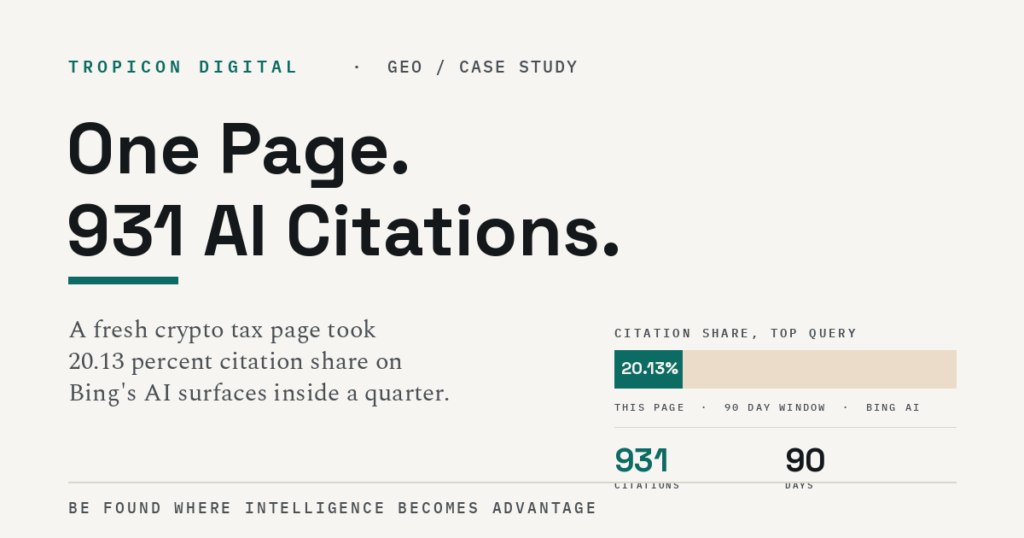
A US based crypto tax publication took a fresh page from zero to 931 AI citations in 90 days across Copilot and ChatGPT, with 20.13 percent citation share on its top query. This is the page level teardown, with the eight mechanics that did the work.
The page did not exist 90 days before the pull. No aged authority behind it, no backlink profile inherited from a previous version, no author brand doing the lifting. What it had was a domain in decent standing on coinscipher.com and a set of choices about how the page itself was built. Ninety days later, that single URL had absorbed 931 citations in the Bing AI Performance surface, which is where brand mentions inside ChatGPT and Copilot answers get counted, and it was more than the next seven pages on the site combined. The interesting question is not whether the number is real. It is what the page did that Koinly, CoinTracker, and the incumbents in this space were not doing on the same queries.
Figure 1 · Hero page dominance
One page absorbed 7.4x more citations than the next best on the same site
What the numbers actually say
Bing AI Performance is a rollup. Copilot grounds its answers in Bing’s index directly, and ChatGPT’s browsing mode routes its live web lookups through the same infrastructure. So a citation counted in this view is either surface serving the page to a live user question. Across the 90 days, one page on the client domain received 931 such citations. The second best page on the same site received 125. That gap is the story, and it is a page level story, not a domain level one.
The queries feeding that page are cost basis and FIFO tracking questions with clear commercial intent. On the top query, the page earned 20.13 percent citation share against every other page cited for that phrasing, which is the kind of share of voice number that is quickly becoming the SEO KPI that actually matters in the AI era. On the next query up in raw volume, 399 citations landed at 5.30 percent share, which reflects a much larger citation pool and a much harder incumbent field. Both numbers matter, and they tell different halves of the same story: the page is defensible on the tighter phrasings and it is showing up at scale on the broader ones.
Figure 2 · Citation share on the winning query
One in five citations for the top query pointed at this single page
The Answer Shaped Page: 8 mechanics
These are the mechanics on the page itself, in the order they matter. The framing “Answer Shaped Page” is the piece of language we use internally to describe this shape, and it sits inside our broader AI search framework. It is deliberately opposed to the older “Authority Shaped Page” that most content teams still default to. Authority shape signals who wrote it and who trusts it. Answer shape signals what the page answers and how retrievable that answer is. Both can work. In Bing AI surfaces on commercial intent research queries, answer shape did most of the work inside the 90 day window.
Figure 3 · Two shapes, two outcomes
Authority shape signals who wrote it. Answer shape signals what it answers.
1. An answer first opening block. The conclusion sits inside the first two or three sentences, before the definitions, before the intro paragraph most tax content leads with. AI engines that lift a passage lift the top of the page more than any other region, and if the top of the page is a throat clearing paragraph about “understanding your crypto tax obligations”, the passage that gets lifted teaches nothing. If the top of the page is the direct answer to the query, the passage that gets lifted is the direct answer.
2. A worked example using real dollar numbers. Not a hypothetical framed as “let us say you bought some Bitcoin”. The page carries an actual transaction sequence with real prices and real dates that a reader can mirror to their own case. This matters for citation for a specific reason: engines rewrite the source’s example into their answer when the example is concrete enough to be portable. A vague example gets paraphrased away. A specific one gets carried.
3. A structured comparison of the accounting methods. FIFO, LIFO, and HIFO framed as tradeoffs, not as a neutral definition dump. Each method gets a short block that says when it wins, when it loses, and what the tax outcome looks like on the same transaction set. The comparison is the thing being asked for on nearly every query that fed the page, so answering that inside the page is what makes it cited when the engine rewrites the query.
4. A named procedure for stepping through the calculation. The page introduces a named method for working cost basis math end to end. Naming a procedure is a small move with a large effect. AI engines cite named things more often than they cite unnamed procedures, because a name gives the engine something to attribute. A method with no name reads as generic and gets summarized without attribution. A method with a name gets quoted with a source.
5. An entity definitions block. Cost basis, capital gain, taxable event, and wash sale are defined in one dedicated block on the page, not scattered across the prose. This is the single unglamorous mechanic that does the most work in retrieval. The block teaches the vocabulary the query is written in, so when the engine looks for a source that speaks in the same terms as the query, this page speaks in exactly those terms and does so in a chunk small enough to be lifted whole.
6. A structured FAQ section that mirrors long tail query variants. Not the “how much tax do I pay” boilerplate FAQ. The FAQ questions on this page are near verbatim to the phrasings AI engines rewrite user queries into before hitting the retrieval index. Each question is answered in two to three sentences, short enough to be lifted as a full answer, long enough to carry the specific claim being asked for.
7. Contextual internal links from more than five related guides on the domain. Not the related posts widget the theme injects. In body, editorial links from five other pages on the domain that already existed, pointing at this page with descriptive anchor text. This is the single most repeatable move in the eight, and the one most teams skip because it requires editing pages that are already published. It also matters because it feeds the domain’s own retrieval graph, so when the engine reads any of those five upstream pages, this page is one hop away with a clear anchor.
8. Published date, last updated date, and FAQ plus Article schema. Both dates are visible on the page, and both dates are also emitted in the JSON LD. The FAQ block on the page is also emitted as FAQ schema, so the same content is present as prose and as structured data. Bing weights structured markup heavily on informational and research queries, and having the FAQ answers present in both places is what makes them the passages that get cited back.
Figure 4 · The eight mechanics as a stack
Retrievability compounds from the top of the page down
One page. Ninety days. 931 citations. No author byline. No paid links. No IRS.gov links inline.
Why this played in Bing surfaces specifically
Bing AI Performance in the tool covers Copilot and ChatGPT because both surfaces read Bing’s index in production. Copilot uses Bing as its grounding layer directly. ChatGPT’s live web browsing routes through Bing infrastructure for its lookups. So a citation in that view is a citation on either or both surfaces, and the count reflects real appearances in live user answers, not a modeled visibility score.
The reason the eight mechanics landed harder in Bing than they would in Google’s AI Overviews is that Bing’s ranking layer weighs structured, chunk retrievable content more heavily than the equivalent Google layer does, and the AI surfaces on top of Bing inherit that bias. The same page probably does not dominate AI Overviews at the same intensity. That is the honest caveat, and it is why the case study is a Bing AI story, not an omni engine story.
The incumbent context
The default cited names in crypto GEO on cost basis and FIFO tracking queries are Koinly and CoinTracker.. Both have aged authority, product led content teams, and years of backlink accumulation. In the general finance overlap, Investopedia and NerdWallet are cited on the softer research queries where the intent leans educational rather than tool oriented. A publication under a year old, on a page under 90 days old, taking 20.13 percent citation share on the top query and 931 citations across the page as a whole means that the incumbency is thinner than the incumbents’ domain authority scores suggest. Aged domain equity is not doing the work in this surface. Page level answer shape is.
What this proves, and what it does not
It proves that page level mechanics can dominate a commercial intent niche in Bing AI surfaces within 90 days, on a page with no author authority footprint and no paid link acquisition, sitting on a domain in decent but unremarkable standing. That is a real result and it changes what a fair timeline for a new GEO engagement looks like on this surface.
It does not prove that the same page dominates Google’s AI Overviews at the same intensity. It does not prove that citations convert to signups or revenue, which is a separate measurement question and one the client is answering with its own analytics rather than with the Brand Radar view. It does not prove that a legal or medical query would move on the same timeline, because those categories penalize a missing credentialed author heavily. And it does not prove that the eight mechanics generalize to short informational queries, which are answered by the engine directly and never cite anyone.
What a founder or CMO should take from this is narrower. On commercial intent research queries in a niche where the incumbents are tool led, and on the Bing surfaces specifically, a fresh page built with the eight mechanics can move inside a quarter. That is worth planning against.
Frequently asked questions
How many citations did the page earn? 931 citations in the 90 day window across Bing AI Performance, which covers Copilot and ChatGPT.
What was the citation share on the top query? 20.13 percent citation share on the top commercial intent query, against every other page cited for the same phrasing.
Was the page on an aged domain? The domain existed and was in decent standing. The page itself was published from scratch inside the 90 day window and had no prior version.
Which engines are counted in Bing AI Performance? Copilot grounds in Bing directly. ChatGPT’s live web browsing routes through Bing infrastructure. Both are counted in the same rollup.
Does the same page dominate Google AI Overviews? Almost certainly not at the same intensity. Google’s AI Overviews weight authority signals more heavily than Bing’s AI surfaces do on commercial intent research queries.