Last updated June 17, 2026
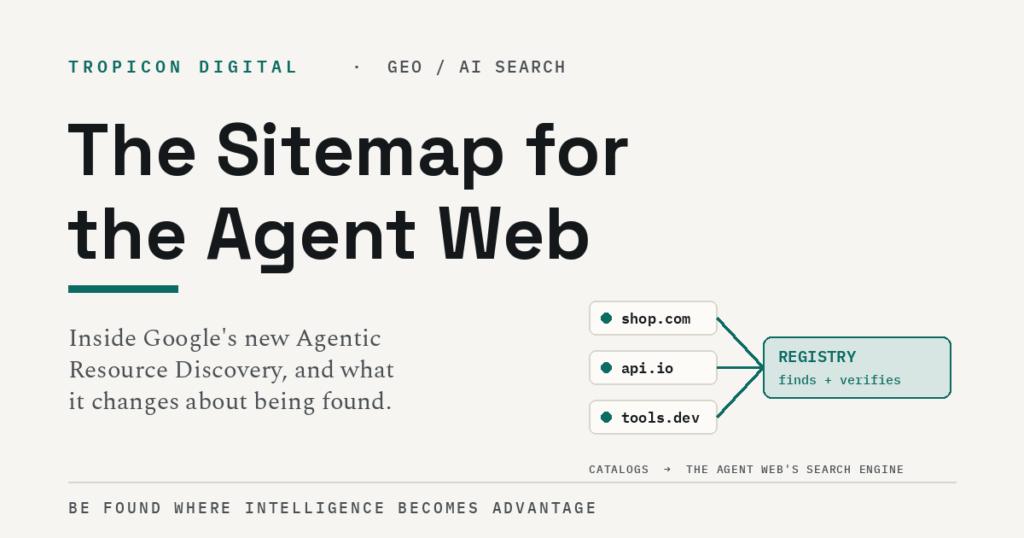
Google just published Agentic Resource Discovery, an open specification that lets AI agents find and verify tools, skills, and other agents across the web. In plain terms it is the sitemap and the search engine for the agent web, and it is the clearest signal yet of where discovery is heading.
On June 17 Google published something most marketers will scroll straight past and most engineers will immediately clock as a big deal, and the honest truth is that both reactions miss the point a little. It is called Agentic Resource Discovery, or ARD, and although it reads on the surface like a dry developer specification, what it actually describes is the discovery layer for a web that is starting to be navigated by AI agents rather than by people, which makes it your problem too, even if you never write a line of code.
The short version goes like this. As AI agents take on real work, they increasingly need to reach for tools, skills, and other agents that live outside their own walls, scattered across different companies and platforms, and right now there is no standard way for an agent to answer three very basic questions, which Google frames as where the right capability lives, which one it should actually use, and how it can confirm the thing is safe to connect to. ARD is an open specification, built with industry partners and released under an Apache 2.0 license, that finally gives the web a shared way to publish, discover, and verify those capabilities.
The line that should make every SEO sit up
Sitting quietly in the announcement is a single sentence that reframes the whole thing for anyone who works in search, because Google describes the registries at the center of ARD as systems that, in its own words, “act as search engines for the agentic web.” It is worth sitting with that for a moment, because it means Google is not merely shipping a developer convenience, it is describing the rebuilding of discovery itself around agents, complete with new search engines, a new place you need to be indexed, and a new way of earning trust. It is the same shift already reshaping ordinary search, where the real work has quietly moved toward getting your brand mentioned by ChatGPT and Perplexity, except ARD points it at agents that act rather than assistants that answer. Nearly everything you already know about being found is about to grow a parallel version aimed at machines instead of people.
Figure 1 · The same job, rebuilt for agents
Every piece of human web discovery has an agent web twin
How ARD actually works, in plain terms
Strip away the jargon and ARD rests on two simple pieces. The first is a catalog, which is really just a file an organization publishes on its own domain, at a well known path, describing the capabilities it offers, whether those are agent tools, other agents, ordinary APIs, or even links onward to further catalogs. The clever part is that because the catalog lives on your own domain, ownership of that domain becomes the cryptographic proof of who you are, which is the same instinct that made domain ownership matter for email and for search, now pointed at agents.
The second piece is a registry, and this is the one that should feel instantly familiar, because a registry crawls those published catalogs, indexes what it finds, and answers discovery requests in almost exactly the way a search engine crawls and indexes pages. An agent can walk up to a registry, describe in plain language what it is trying to do, and get back a list of matching capabilities along with the metadata it needs to verify the publisher before it commits to anything. Once that handoff is done ARD politely steps out of the way and lets the agent talk directly to the tool using the tool’s own native protocol.
Figure 2 · The runtime path
Publish, discover, verify, connect
Figure 3 · The two primitives
Catalogs publish. Registries index and answer.
Why domain ownership is quietly the whole game
If you take one strategic idea away from this, make it this one. In the agent web that ARD describes, trust is anchored to your domain. The catalog lives under your domain, and a verifiable trust layer lets an agent confirm your real cryptographic identity before it connects to anything at all. That should sound familiar, because it is the same lesson the human web spent decades teaching, that your domain is the asset you genuinely own and the place your reputation accrues, except here it is being wired in as the literal foundation of identity rather than a ranking signal you merely hope to influence.
Figure 4 · Trust starts at the domain
Owning the domain is what proves who you are
Who needs to care today, and who can just watch
Here is the honest part, because the internet is about to fill up with posts telling you to drop everything and publish a catalog this afternoon, and for most businesses that is simply not the right move yet. If your company exposes tools, APIs, or agents that other people’s software might want to call, then ARD is immediately relevant and worth a real look, because publishing a catalog is how those capabilities become discoverable and trusted in the new layer, and Google says you can stand one up in minutes. If your product is content, services, or a storefront rather than callable software, then ARD is not a channel you optimize today, and anyone selling you that is running ahead of the facts.
Watching closely, though, is not at all the same as doing nothing, because the direction here is unmistakable. The discovery layer is being rebuilt around agents, it now has its own search engines, its own version of a sitemap, and its own currency of trust, and the people who understand how registries decide what to surface will carry the same kind of head start the earliest SEOs did. We have all seen this film before. The brands that treated search as plumbing worth understanding early went on to compound that advantage for a decade.
Figure 5 · Where you sit right now
Act now if your software is callable. Otherwise, watch closely.
What it means if you are a founder, a CMO, or an SEO
For a founder, the takeaway is that if any part of your product is software other systems could call, the cost of publishing a catalog is low and the option value of being discoverable in the agent web early is real, so it belongs on the roadmap rather than the someday pile. For a CMO, the reframe is that AI discoverability is quietly becoming an infrastructure question and not only a content one, and the teams that come out ahead will be the ones who start treating their domain as the trusted identity it is about to formally become, and who start measuring their presence with the AI era KPIs that are replacing rankings and traffic. For an SEO, this is the most important thing to internalize all year, because your craft is about to stretch from getting indexed by one search engine to being discoverable and verifiable across a whole federation of registries, and the fundamentals you already live by, crawlability, clean structured description, and domain authority, every one of them has a direct descendant sitting in this spec.
The web spent twenty five years getting good at being found by people. ARD is the starting gun on doing it all again for agents.
What to actually do now
None of this calls for panic, just a couple of deliberate moves. Read the specification yourself rather than the takes about it, because it is short and the core ideas are genuinely simple. If you expose any tools or APIs, try publishing a catalog on a test domain and see how it feels, since the fastest way to understand a discovery layer is to actually be inside it. And keep a close eye on which registries start to gain traction, because exactly as with search engines, the ones that win the crawl will quietly decide what agents are able to find.
For the broader agent readiness picture beyond discovery, our breakdown of how Lighthouse now scores sites for AI agents is a useful next read.
The honest answer to what ARD means for you depends entirely on what you sell. The honest answer to whether it matters is yes, because discovery is being rebuilt from the ground up, and it is always better to understand the new map while it is still being drawn than to go looking for it once everyone else already has.