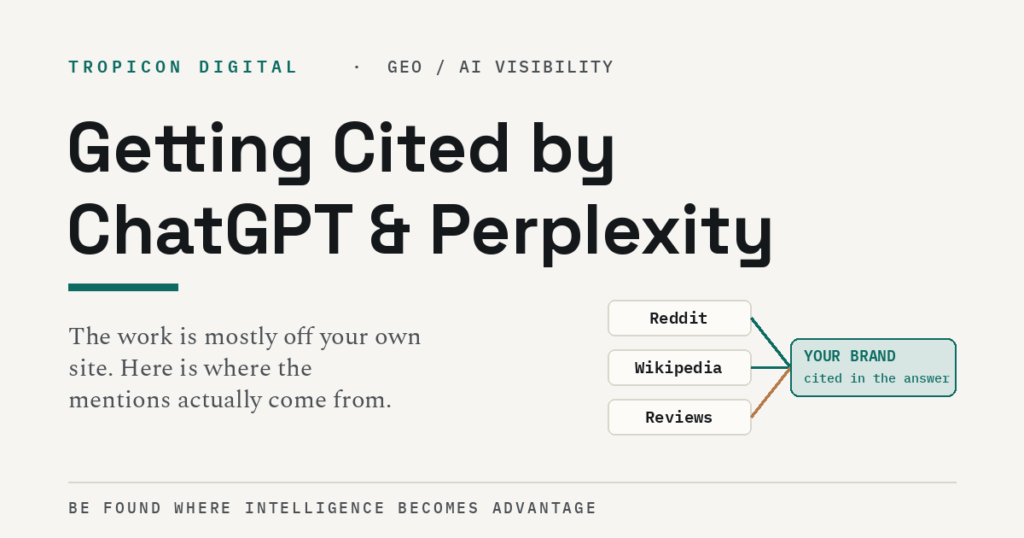
If you want ChatGPT or Perplexity to bring up your brand when a buyer asks, most of the work is not on your own website. These engines build their answers out of the third-party sources they already trust, so getting mentioned comes down to earning a credible place in those sources, making your own pages genuinely easy to quote, and keeping all of it current.
Let me give you the honest version up front, because it is not the version most agencies lead with. ChatGPT and Perplexity do not bring up your brand because you wrote a brilliant page about yourself. They bring it up because, in the second after someone asks a question, they go and pull together a handful of sources they happen to trust, and your name is sitting inside one of them. And when you look at which sources those actually are, the ones the engines cite most often are third-party platforms like Reddit, Wikipedia, YouTube and LinkedIn, not company websites (Search Engine Land, 2026). Which means most of the work we are about to walk through does not happen on your site at all. So let me show you how the whole thing actually fits together.
First, how they actually decide who to mention
Start with how these tools actually work, because it quietly changes everything you should do next. An AI engine does not carry a running memory of your brand the way a person might. When someone asks it to recommend tools in your category, it is not reaching into some fixed list it picked up months ago. It goes and retrieves, right there in the moment, pulling in current sources and assembling an answer with citations attached to them. Roughly 31% of ChatGPT prompts now kick off a live web search (Search Engine Land, 2026), and Perplexity is built around retrieval from the ground up.
Once that clicks, the whole question changes shape. Whether you get mentioned has very little to do with how long your company has been around or how polished your homepage looks. It comes down to whether you are present, quotable, and current in the exact sources the engine reaches for the instant someone asks. That is the part you can genuinely influence, so that is where everything below is aimed.
Figure 1 · How a mention actually happens
The engine retrieves at query time, then cites
The two engines do not read the same internet
Here is where a lot of teams quietly burn their budget. They put together one “AI strategy” and push it out everywhere, as though ChatGPT and Perplexity were the same animal. They really are not. The two engines pull from genuinely different places, and the thing that earns you a mention on one will often do nothing for you on the other.
This is not a hunch, it has been measured, and the number is more extreme than most people expect. Several independent analyses in 2026 converged on the same finding, that only around 11% of the domains cited by ChatGPT and Perplexity are cited by both, with Ahrefs putting cross engine overlap at roughly 12% at the query level. The practical translation is uncomfortable, because if you measure your AI visibility on a single engine, you are blind to close to nine tenths of where the other one is actually looking.
Figure 2 · What each engine tends to favor
Two engines, two source diets
The practical version is this. Winning Perplexity is mostly about recency and a real, credible presence in the communities where people actually compare their options. Winning ChatGPT leans more on durable, widely referenced authority, the kind that Wikipedia and established publications confer on you slowly over time. The good news, and the reason this is not twice the work, is that the foundation underneath both is the same. They both reward you for being cited by sources other people already trust.
The Bing pathway almost everyone forgets
There is one technical detail about ChatGPT that quietly decides whether you can be cited at all, and most teams never think about it. When ChatGPT searches the web, it does not run on Google’s index, it runs on Bing’s. So if your pages are indexed and ranking in Google but missing or buried in Bing, they are effectively invisible to ChatGPT no matter how strong your Google presence is (Search Engine Land, 2026). One analysis of SearchGPT citations by Seer Interactive found that roughly 87% of them matched Bing’s top results, which tells you how tightly the two are wired together, and the same backbone powers Microsoft Copilot.
The fix is refreshingly old fashioned. Verify your site in Bing Webmaster Tools and confirm your important pages are actually in the Bing index, because the gap between what Google has crawled and what Bing has crawled is usually wider than people expect, especially for newer pages and smaller domains. Use IndexNow to push new and updated pages to Bing within minutes rather than waiting for a crawl. Make sure your key content is server side rendered, since the bot ChatGPT uses to fetch a page does not run JavaScript the way a full browser does. And take the small gift Bing hands smaller brands, because it leans on exact match phrasing and freshness more than Google does, which can give a newer site a faster route onto the shortlist than the backlink heavy climb Google demands.
Step 1: Find out who they cite now
Before you write a single word or pitch a single journalist, do the audit, because the engines will tell you exactly what they want if you simply ask them. Take the 15 or 20 questions your buyers genuinely type in, run them through both ChatGPT and Perplexity, and actually read the list of sources sitting under each answer. That list is the engine handing you its own reference shelf, no guessing required.
What you will almost always see is your competitors turning up through Reddit threads, listicles, comparison posts, review sites and niche directories, rather than through their own homepages. Those recurring sources are your target list, and the moment you have them the job stops feeling vague. It is no longer “do some GEO.” It is “get credibly mentioned on these specific pages.” And if you want to turn all of this into a number you can actually report on month to month, the metric to watch is citation share of voice, which I walk through in the new SEO KPIs for the AI era.
Figure 3 · The audit loop
The engine shows you its sources. Read them.
Step 2: Win the third-party layer, because that is where the citations live
This is the part that feels backwards the first time you hear it, and it is also the part that matters most. The bulk of your effort belongs off your own website entirely.
Figure 4 · Where AI citations come from
Earned media does most of the work
So most of the real work is digital PR and earned mentions. It is getting your brand named in the comparison pages and listicles the engines keep pulling from. It is making sure your profiles on the directories and review platforms in your category are complete, accurate, and actually maintained. And if you genuinely qualify for one, it is earning a real Wikipedia or Wikidata entity, which carries far more weight with these systems than most people expect.
Reddit deserves a paragraph of its own, because its influence here is genuinely hard to overstate. It is the single most-cited domain across the major AI engines, and Perplexity in particular leans on it heavily (Search Engine Land, 2026), while ChatGPT pulls most of its answers from Wikipedia and Reddit (Semrush, 2026). There is a real catch, though, and you want to take it seriously. The only version of this that works is honest participation, actually useful answers in the communities your buyers already spend time in, not threads you quietly manufacture to plant your own name. The engines are getting more discerning by the month, and people are getting better at smelling a planted post from across the room. If it reads as astroturf, it gets treated as astroturf, by the humans and the machines alike.
This is also where guest content earns its keep, because the fastest way onto a page an engine already trusts is to write part of it yourself. Pitching contributed articles, expert commentary, and inclusion in the roundups and comparison posts that keep surfacing in your audit puts your name directly into the sources the engines pull from, which matters a great deal when close to half of ChatGPT’s citations point to third party directories, reviews, and similar pages rather than to brand sites (Yext analysis of 6.8 million citations, 2026). Treat it as digital PR with a target list, the specific publications and pages your audit surfaced, rather than a generic outreach blast.
Underneath all of this sits a quieter foundation, which is whether the engines recognize your brand as a real, distinct entity in the first place. The models lean heavily on the structured knowledge in places like Wikipedia, Wikidata, and Google’s Knowledge Graph to work out who you are and whether you are credible, so a consistent presence across them, the same name, the same description, and the same core facts everywhere, makes you far easier to surface and to trust. If you genuinely qualify for a Wikipedia entry or a Wikidata record, earning one is among the highest leverage moves available to you, because it feeds the entity layer that every engine quietly reads from.
Step 3: Make your own pages easy to quote
None of this means your own website stops mattering. It just has a different job now. It is no longer there to chase a keyword ranking. It is there to be the clean, quotable source the engine reaches for when it wants a precise, confident answer about your space. That is what people are pointing at when they say citation-grade content, and it is more concrete than it sounds.
Figure 5 · Anatomy of a citable page
Built to be quoted, not just to rank
In practice that means leading with the answer in your very first sentence instead of burying it six paragraphs down. It means turning the real questions your buyers ask into your actual H2 headings. It means naming every statistic right alongside its source, because a clean sourced number is exactly the kind of thing an engine likes to lift straight into an answer. It means keeping your key passages short and self-contained enough to quote without dragging in the surrounding context. And it means adding structured data, so the machine is never left guessing about what it is actually looking at.
Step 4: Keep it fresh, because recency is a ranking factor now
Freshness used to be a nice-to-have. It really is not anymore. Citation positions turn out to be genuinely volatile, with a single source’s share swinging hard within a matter of weeks as the engines quietly re-weight what they trust (Semrush, 2026). A page that was earning you citations last quarter can slide right out of the answer this quarter, simply because something newer turned up to take its place. Which is why the cornerstone pages you care about are never really finished. They go on a refresh schedule, the same way you would maintain anything else your business leans on.
Figure 6 · Citation likelihood by content age
Fresh content gets cited. Stale content fades out.
Deep Research mode is a higher bar, and a bigger prize
Everything so far assumes a normal answer, where the engine grabs a few sources and replies in seconds. There is a second surface worth understanding on its own, though, because it behaves quite differently. When someone runs ChatGPT or Perplexity in Deep Research mode, the engine stops being a quick answer machine and turns into an agent that browses for several minutes and, in OpenAI’s own words, finds, analyzes, and synthesizes hundreds of online sources into a single cited report. Perplexity’s version tends to finish in a couple of minutes, while ChatGPT’s can take anywhere from five to thirty.
That shifts the math in your favor in one important way. A normal answer might cite three or four sources, which makes the competition for a slot brutal, but a Deep Research report can cite dozens, so there is far more room to be included, provided your content is the kind a research analyst would actually keep. This is the surface that rewards genuine depth, original data, a clear methodology, and named sources, the very things that look like overkill for a quick reply and turn out to be exactly right for a long investigation. If you have ever wondered where the heavily researched, genuinely expert version of a page earns its cost back, this is where it happens.
Step 5: Measure it, engine by engine
You cannot improve what you are not measuring, and here a single blended “AI visibility score” actively hides the most useful thing you could know. Run your fixed set of questions every month across ChatGPT and Perplexity separately, and report citation share of voice for each engine on its own, along with how each one describes you on the occasions it does bring you up.
That per-engine view is exactly what tells you where to push next. If you are getting cited all over ChatGPT but you are nowhere on Perplexity, you already know the fix is recency and community presence. If it is the other way around, you know you need the kind of durable authority that Wikipedia and the established press confer. I lay out the full measurement framework, including the metrics that quietly replace rankings and raw traffic, in the new SEO KPIs for the AI era.
Figure 7 · The playbook in one view
Five steps, repeated every month
How long until you actually get cited
The honest answer is that it depends on the engine, and the spread is wider than most people expect, which is exactly why setting the expectation up front saves a lot of grief later. Perplexity is the fast one, because it retrieves in real time, so a new page can begin appearing in its answers within hours of being indexed, and a focused push often shows movement in two to four weeks. ChatGPT runs on Bing’s clock, so once a page is properly indexed in Bing it can surface fairly quickly for current queries, though the lag is tied to indexing rather than to anything you can force on the day. The slowest and most durable layer is entity and authority, the earned mentions, the Wikipedia and Knowledge Graph presence, the third party citations, all of which build over months rather than weeks but also hold the longest once they land.
The sane way to run this is to treat Perplexity as your early warning system, since it gives you the shortest feedback loop, so you can see whether the work is landing there first, then watch ChatGPT follow as Bing catches up, and judge the slow compounding entity work on a horizon of quarters rather than days.
Figure 8 · When citations tend to show up
Perplexity is fast, ChatGPT follows Bing, authority compounds
What not to do
A few quick ways to set fire to your budget, so you can sidestep them. Do not spam Reddit with thin promotional posts, because the communities will downvote you into oblivion and the engines are actively learning to discount exactly that kind of behavior. Do not crank out a wall of generic blog content and hope sheer volume earns you citations, because filler is the precise opposite of citation-grade and the engines can tell the difference. And do not try to manufacture authority you have not actually earned, because that kind of presence is brittle, and it tends to get stripped right out the moment an engine tightens up its trust signals.
The brands getting mentioned are not the loudest. They are the ones the trusted sources already vouch for, in language an engine can lift cleanly into an answer.
Getting mentioned by ChatGPT and Perplexity is earned rather than bought, and it compounds the way real authority always has, slowly and then all at once. If you are sitting there weighing whether this is even worth the investment against everything else competing for your attention, I make that whole case in should B2B SaaS companies still invest in SEO. And if you would rather just see where you actually stand right now, before you spend a thing, run the audit from Step 1 against your own category and read the sources the engines hand back. That single exercise usually tells you more in an afternoon than a quarter of guessing ever would.
Frequently asked questions
How do I get my brand mentioned by ChatGPT and Perplexity?
Most of the work is off your own website. These engines build answers from the third-party sources they already trust, like Reddit, Wikipedia, review sites and listicles, so the job is to earn a credible place in those sources, make your own pages genuinely easy to quote, and keep everything current. Start by auditing which sources the engines already cite in your category.
Do ChatGPT and Perplexity use the same sources?
No. They have genuinely different source diets, so one blended strategy underperforms. Perplexity rewards recency and community sources, with Reddit a large share of its citations, while ChatGPT leans more on Wikipedia and established references. Track each engine separately and work the gaps.
Why is my brand not showing up in AI answers?
Because these engines retrieve sources at the moment of the question rather than recalling a fixed list, and your brand is not present in the ones they trust. Run your buyers’ real questions through ChatGPT and Perplexity and read the citations under each answer. That list of recurring sources is exactly where you need to earn a mention.
Does my own website still matter for AI citations?
Yes, but its job has changed. Instead of chasing a keyword ranking, your pages need to be citation grade: lead with the answer in the first sentence, turn buyer questions into H2 headings, name every statistic with its source, keep passages short and quotable, and add structured data so the engine can parse what you are.
How do I measure whether AI engines are citing my brand?
Run a fixed set of buyer questions every month across ChatGPT and Perplexity, and report citation share of voice for each engine separately, along with how each one describes you when it does mention you. A single blended score hides the most useful signal, which is where one engine cites you and another does not.
Is Reddit important for getting cited by AI?
Very. Reddit is the single most-cited domain across the major AI engines, and Perplexity in particular leans on it heavily. But it only works through genuine participation, real and useful answers in the communities your buyers already use. Manufactured threads get discounted by the engines and spotted by the communities.
Does ChatGPT use Bing or Google?
ChatGPT’s web search runs on Bing’s index, not Google’s, so a page that ranks in Google but is missing from Bing can be invisible to ChatGPT. Verify your site in Bing Webmaster Tools, confirm your key pages are indexed there, and use IndexNow to push new and updated pages to Bing quickly. The same Bing backbone also powers Microsoft Copilot.
How long does it take to get cited by ChatGPT or Perplexity?
It depends on the engine. Perplexity retrieves in real time, so new content can appear within hours of being indexed and a focused push often shows movement in two to four weeks. ChatGPT surfaces content after it is indexed in Bing, while entity and authority signals such as Wikipedia and earned mentions build over months but last the longest. Treat Perplexity as your early read.