SEO is not dead for B2B SaaS, but the version most agencies still sell is. The real decision is whether to keep paying to rank for keywords or to start becoming the source AI assistants cite when your buyer researches. For some companies, the honest answer this quarter is not yet.
SEO is not dead. But the product most agencies still sell under that name is dying, and if you sign a retainer without knowing which one you are buying, you will spend a quarter of runway finding out the hard way.
That distinction is the whole question. So before you approve a budget or take a single sales call, it is worth getting underneath the word “SEO” and asking what you are actually paying for.
First, what are you really buying when you buy SEO
Strip away the tactics and SEO has only ever done one job: put your company in front of a buyer at the moment they are trying to solve the problem you solve, before they have picked a vendor. You are buying a place in the shortlist while the shortlist is still forming.
For fifteen years that place was a blue link on a Google results page. The tactics, keywords, backlinks, technical fixes, all existed to win that link. People treated the link as the product. It was never the product. The product was being there when the buyer was deciding.
Hold onto that, because it is what makes the “is SEO dead” question answerable. The link is fading. The job is not. The buyer is still researching before they talk to you. They have just moved where they do it.
Where your buyer actually went
Your buyer moved into the dark funnel, and now into the machines that sit on top of it.
B2B buyers research through communities, content, and peer networks long before they ever speak to sales, which is exactly why attribution has gotten so hard (SaaS Hero, 2026). The newest layer on that behavior is the AI assistant. A founder or operator now opens ChatGPT or Perplexity and asks it to explain the category, name the options, and compare them, and most of that happens with no click back to anyone’s website. In US Google search specifically, 68% of searches now end with no click at all (SparkToro, 2026).
Figure 1 · Where the research happens now
Most searches end inside the answer, not on your page
So the link is disappearing for a measurable reason. The buyer is getting the answer inside the assistant and the search engine, not on your page. If your entire SEO investment is aimed at winning a click that fewer and fewer people make, then yes, that version is dying, and an agency selling it to you in 2026 is selling you a 2019 asset.
The opportunity is the other half of the same shift. Those AI answers are built from sources. Something gets cited. The new version of the job, getting your company named and recommended inside the answer, is wide open, and most of your competitors have not noticed it yet.
The math has quietly turned in SEO’s favor
Here is the part the “SEO is dead” headlines miss. The economics of the alternative got worse at the same time.
Customer acquisition cost across B2B SaaS is up 40% to 60% since 2023, driven by paid channel inflation, longer buying committees, and the loss of clean attribution (SaaS Mag, 2026). The median company now spends two dollars of sales and marketing to generate one dollar of new ARR, a 14% jump from 2023 (Benchmarkit, 2026). Google Ads now runs an average cost per lead around 70 dollars, with B2B SaaS click costs up 57% against their long term average (SaaS Mag, 2026). For fintech specifically, blended CAC sits between 800 and 1,600 dollars per customer (SaaS Hero, 2026).
Figure 2 · Paid acquisition, change since 2023
Every paid lever got more expensive at once
Meanwhile the median B2B SaaS company takes 15 months to pay back the cost of acquiring a customer, and investors are pushing hard for under 12 (Benchmarkit, 2026). Every channel that lengthens that payback is now a liability on the balance sheet, not just a line in the marketing plan.
Figure 3 · CAC payback period, B2B SaaS median
Payback has stretched past the line investors want
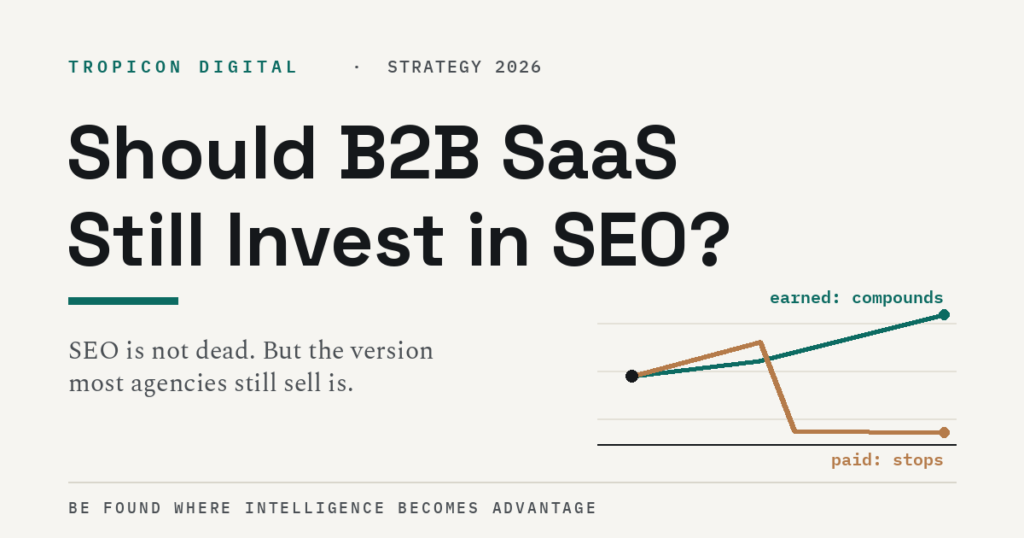
This is why the decision is not really about SEO. It is about where the next acquisition dollar earns its keep. Paid buys you attention that stops the moment you stop paying, at a price that keeps climbing. Earned presence in search and AI answers compounds, costs nothing per query once it exists, and quietly lowers blended CAC over time. One is rent. The other is an asset you own.
Figure 4 · Rent versus asset
Paid stops when the spend stops. Earned presence compounds.
In an environment where payback discipline now decides who gets funded, the channel that builds an asset is the strategically obvious one, even though it is slower.
When the honest answer is “not yet”
It would be easy to stop there and tell you to invest. We will not, because for some B2B SaaS companies this is the wrong quarter, and an agency that cannot say so is not protecting your business.
Do not put real money into SEO or GEO yet if any of these is true.
You have not found product market fit. If you are still changing who you sell to and what you say, content built this month will be wrong next month. Buy speed with paid until the message stabilizes, then build the asset.
Your sales cycle needs cash this quarter to survive. SEO and GEO pay back over two to four quarters, not two to four weeks. If runway is the constraint, the fast channel wins now and the compounding channel waits.
Your category has almost no search and no AI demand. A few brand new categories genuinely are not being searched or asked about yet. There, you are creating demand, which is a different and more expensive job than capturing it.
If none of those apply, the cost of waiting is the real risk, and we will come back to that.
What “investing in SEO” should mean for you now
If you do invest, the brief has changed. The goal is not a ranking report. It is to become the source that both Google and the AI assistants pull from when your buyer is forming a shortlist. That breaks into three things worth paying for.
Figure 5 · What the budget should actually buy
Three things, not a pile of blog posts
Content that earns citation, not content that fills a calendar. AI answers draw most of their citations from sources outside your own website. Muck Rack’s analysis of more than a million AI prompts found that roughly 85% of AI citations come from earned media rather than brand owned pages, and McKinsey’s discovery research put a brand’s own site at only 5 to 10% of the sources AI engines reference (Muck Rack and McKinsey, 2026). Investing well means producing genuinely original, evidence backed material and getting it onto the surfaces the engines already trust, not publishing one more generic post nobody will quote.
Measurement that a CFO would accept. You should be tracking branded search growth, your citation share inside AI answers, and revenue per visit, not just traffic and rankings. Those first two move weeks before revenue does, which gives you a real early signal that the investment is working long before the payback lands.
A system, not a sprint. The reason SEO earns its place on the balance sheet is that it compounds. Each cited page strengthens the next, branded demand feeds itself, and the cost per acquired customer keeps falling as the asset grows. That only happens if the work is built to repeat and scale, which is the difference between hiring a content vendor and building an acquisition channel.
The decision, in five questions you can answer today
You do not need an agency to make this call. Run this on your own first.
Figure 6 · The kickoff decision
Invest now, or wait one more quarter
Four yeses and one honest no on measurement is still a go, as long as you fix the measurement. Two or more nos near the top means not this quarter, and any agency worth hiring will tell you the same.
The cost of waiting is the part nobody prices
Here is what makes this urgent rather than optional. The citation layer is being decided now, while it is cheap.
Figure 7 · The closing window
Winning a cited position gets more expensive the longer you wait
When an AI assistant recommends three tools in your category, it is pulling from a pool of sources that is still thin and still winnable. The companies building cited, trusted presence today are teaching the models who the credible options are, and that position compounds. The longer you wait, the more expensive it gets to dislodge whoever got there first, in exactly the way it became expensive to outrank an incumbent on Google a decade ago.
The real question was never whether SEO is dead. It is whether you would rather be the company the machines cite, or the company explaining to the board why a competitor owns the answer.
SEO, done as it is actually practiced now, is how you become the first one. That is worth investing in, for most B2B SaaS companies, starting before the window closes.
If you want to know which side of that line you are on today, an AI visibility audit shows you exactly where your brand stands in AI answers across your category, and what it would take to be cited.